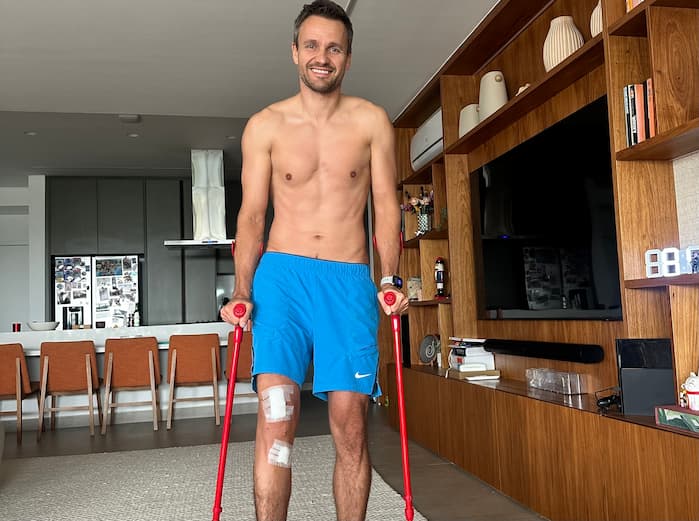
Woke up feeling much better. WOW!
For the first time, I can almost lift my leg on my own. I still need to give it a small boost at the beginning, but once it starts moving, it goes. I can put my foot on the ground with much less pain. Walking around the house suddenly feels possible.
I am still on medication, but something important changed. I am no longer counting the minutes until the next dose. That alone feels like progress.
I worked much more today. My mind feels clearer. More present. More engaged.
Today was also my return to the doctor. I was genuinely excited and full of questions. Medication, physiotherapy, positions, braces, and everything I had read online.
Getting in and out of the taxi is still a struggle, but I am learning. Each movement feels less chaotic. I am much more confident with crutches now. I move slowly and deliberately. When I do that, the loose knee feeling disappears. I have learned that lightly engaging the muscles makes everything feel more stable.
Whenever I stand, even in the elevator, I focus on straightening my leg.
At the clinic, the doctor removed the bandage. First time seeing the wound. It looks impressive. But without the bandage, the knee actually feels better.
The doctor is happy with the surgery. He walked me through everything in detail and answered all my questions. One key detail stood out. The graft was taken from my quadriceps. That explains the quad pain.
It is a newer technique and, according to him, the strongest and biggest graft available, behaving very similarly to a natural ACL. He even shared that he had the same graft done on his own knee five years ago. At the time, it was still considered fairly new and more demanding for the surgeon. Patellar or hamstring grafts are much easier. That gave me a lot of confidence.
My doctor is a black belt judoka. He understands my profile. I am an athlete and I want to return to everything I love. Tennis, kitesurfing, surfing, snowboarding, wakeboarding, golf. These are all rotational and impact sports. The goal is not just recovery. It is resilience.
Regarding braces, he was very clear. They are no longer used. According to recent research, they often make things worse, not better. The focus now is mobility. I need to move the leg.
This is where online advice and real medical guidance clearly diverge. According to him, I should already be working toward ninety degrees of knee bend. That is the goal.
He recommended a simple exercise. Sitting with a skateboard, roller, or ball under the foot, moving the leg forward and back to bend the knee. We also need to activate the quads.
After coming home, I started with ankle pumps and rolling the leg back and forth. I am still taking medication, but overall I feel much better.
I went to sleep feeling calm.
Today felt like a turning point.
Key Takeaways
- Early progress can arrive suddenly and shift motivation
- Regaining basic leg control builds confidence quickly
- Understanding the surgery details reduces fear and confusion
- Seeing the wound helps mentally accept what happened
- Quad graft explains pain and reframes expectations
- Trust increases when the surgeon aligns with athletic goals
- Modern recovery prioritizes mobility over braces
- Light muscle engagement improves stability when standing
- Clear guidance is more valuable than conflicting online advice
- This phase marks the transition from survival to recovery