Forearm Crutches: My "Ferrari Red" Best Friends
For 8 weeks, these crutches spent more time with me than my wife and kids. They traveled the world with me, but the story of how I got them, and kept them, is a journey of its own.
The Italian Connection
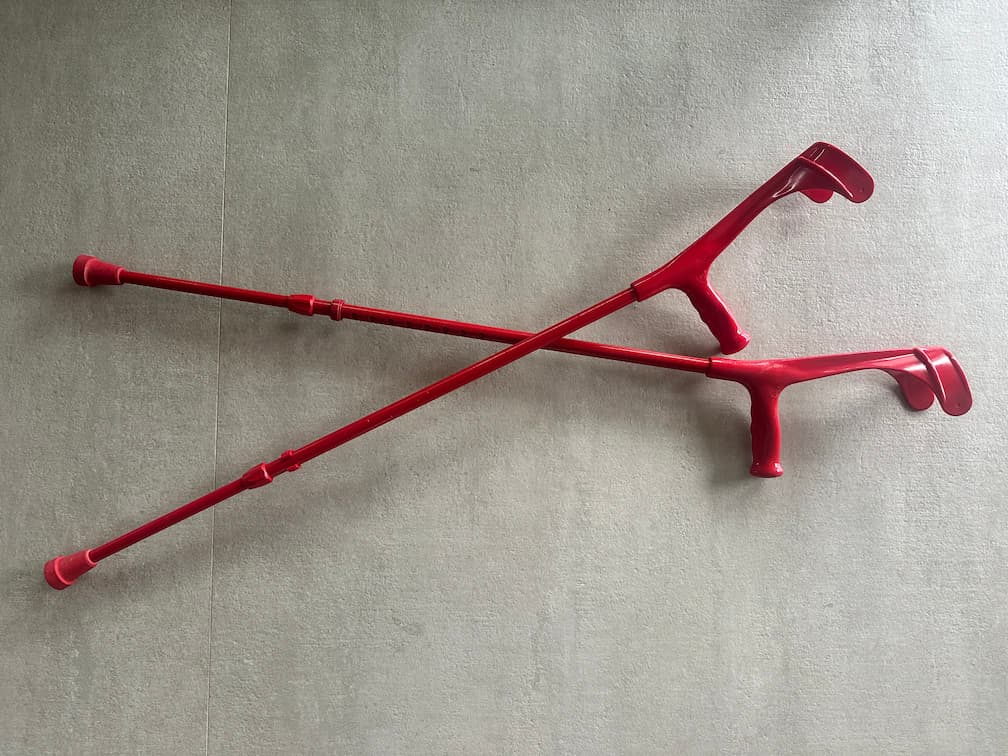
It started with a loan. An Italian friend of mine handed me a pair of striking, aluminum forearm crutches. He called the color "Ferrari Red." They weren't just medical devices; they were conversation starters at every airport and cafe from here to the other side of the world.
I used them, or rather, abused them, so much during my global travels that by the time I needed to return them, they were exhausted. I couldn't just give back a trashed pair of "Ferraris," so I set out to buy the exact same model.
It wasn't easy. Finding that specific fashion statement required a feat of international "smuggling," dealing with complex shipping, and paying heavy tarrifs just to get them across the border. But for the luck they brought me, it was worth every cent.
"They were my eight-week shadow. They supported me when I couldn't support myself, but they also taught me that your arms have a breaking point."
The Physical Toll: When the Arms Take Over
Everyone talks about protecting the knee. Almost nobody talks about what happens to the arms.
Using crutches constantly shifts a surprising amount of load upward. At one point, I started feeling weakness in my right hand and fingers, almost like the strength was draining away. It was unsettling. I never had a confirmed nerve pinch, and I can’t say exactly what it was. My arms are strong, the crutches were decent quality, and I wasn’t doing anything obviously wrong.
What became clear, though, was the pattern.
The more weight I put through my arms, the worse it felt. When I consciously reduced that load, improved my walking pattern, and relied less on brute force through the handles, the strength gradually returned.
It was a reminder that compensation has a cost. Even when you think you’re strong enough, repetitive pressure can overwhelm the system. The body adapts fast, but it also signals clearly when something isn’t working.
Listening early makes the difference.
The Path to Freedom
The "Two-to-One" Transition
When your doctor or physio gives you the green light to move to one crutch, remember the golden rule: The crutch goes on the opposite side of the bad leg. If your right knee is the surgical one, the crutch goes in your left hand. This allows you to shift weight naturally.
Ditching the Last One
Do not rush this. You "ditch" the crutches only when your gait is stable and you aren't limping. Walking with a limp without crutches is worse for your long-term recovery than staying on one crutch for an extra week.
Aluminum (The Workhorse)
Light, rigid, and reliable for heavy travel.
- ✅ Easy to adjust height on the fly
- ✅ Light enough for airplane overhead bins
- ❌ Harder on the wrists than carbon fiber
Carbon Fiber
For those who need maximum shock absorption.
- ✅ Ultra-light (great for weak shoulders)
- ✅ Natural "flex" absorbs ground impact
- 💰 Costly and harder to replace if broken abroad
Crutch Survival Tips
Conversation Starter
Embrace the color! A bright pair of crutches makes you visible in crowds (safe) and acts as a great ice-breaker. My "Ferrari Reds" made me friends in three different continents.
Mind the Fingers
If you lose strength in your hand, check your height adjustment. Your elbows should have a 15-30 degree bend. If they are too high, you’re putting direct pressure on the nerves in your palm.