Small routines are starting to form.
Exercise. Breakfast. News. Work. Nothing special, and that’s exactly why it matters. Structure is slowly coming back.
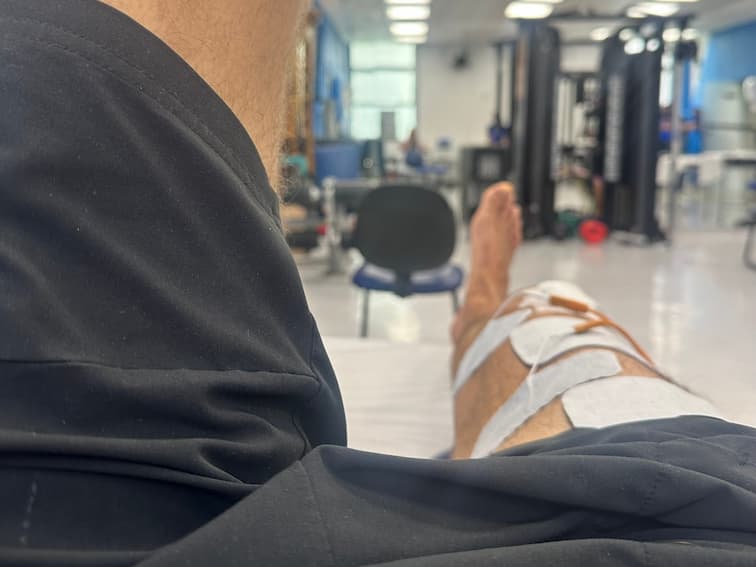
Today I started physio at the club. Bruna. I liked her right away. Clear, confident, and practical. She explained everything well and immediately corrected something important. I have been using crutches wrong.
Apparently, I was hopping too much with a bent leg..
The goal is different. You should really try to straighten the leg and slide it forward, mimicking a walking pattern, while using the crutches to offload weight. Less jumping. More control.
It felt better. More stable. More correct.
Still, the session wiped me out. I got home and slept for an hour straight.
Then, because apparently I don’t learn, I went to another event.
One hour of socializing and networking. One and a half hours listening to a talk by the Buscapé founder. Another 45 minutes of networking afterward.
It was interesting. Inspiring. And completely exhausting.
By the time I got home, my knee was like a balloon. Swollen, heavy, angry.
I was done.
The most difficult part of the day wasn’t the physio or the event. It was taking off my shoes. Jeans. Socks. I couldn’t do it alone. I had to wake my wife to help me.
I’m incredibly grateful she’s there. Truly. If I were alone, I’d probably sleep in my shoes.
Recovery keeps humbling you in unexpected ways.
Key Takeaways
- Small daily routines create a sense of normality and control
- Proper crutch technique reduces strain and improves stability
- Mimicking a natural walking pattern matters more than speed
- Physio sessions can be more exhausting than expected
- Social and professional events carry a high physical cost
- Swelling is the body’s clear response to overload
- Simple tasks become major challenges when fatigue hits
- Accepting help is part of recovery, not a weakness
- Gratitude for support grows through moments of dependence
- Recovery continues to humble in unexpected ways